
Why Accurate Measurement Matters
Accurate measurements keep the project budget under control. If your square footage is too low, you risk running short on pavers, gravel, sand, and edge restraint. If it is too high, you end up paying for material you may never use.
Both DIY installers and contractors need clean area numbers before pricing materials. The footprint is the starting point for paver count, waste allowance, base depth, bedding sand, and overall installed cost.
Measure the paved footprint first, then turn that footprint into a calculator-ready number. Once the area is correct, the rest of the estimate becomes much easier.
Tools You'll Need
You do not need advanced survey gear for most patio or walkway layouts. A few simple layout tools are enough for most residential projects.
| Tool | What it helps you do |
|---|---|
| Tape measure | Measure the main length, width, or diameter |
| Graph paper | Sketch the footprint and label each dimension |
| Stakes and string | Mark straight boundaries and hold reference lines |
| Spray paint | Outline curves, corners, and excavation limits on the ground |
| Calculator or phone | Convert measurements into square footage and paver count |
Lay out the planned shape with a garden hose, scrap lumber, or string before you measure. Seeing the footprint on the ground helps you catch awkward corners and overbuilt dimensions early.
How to Measure a Rectangular Paver Area
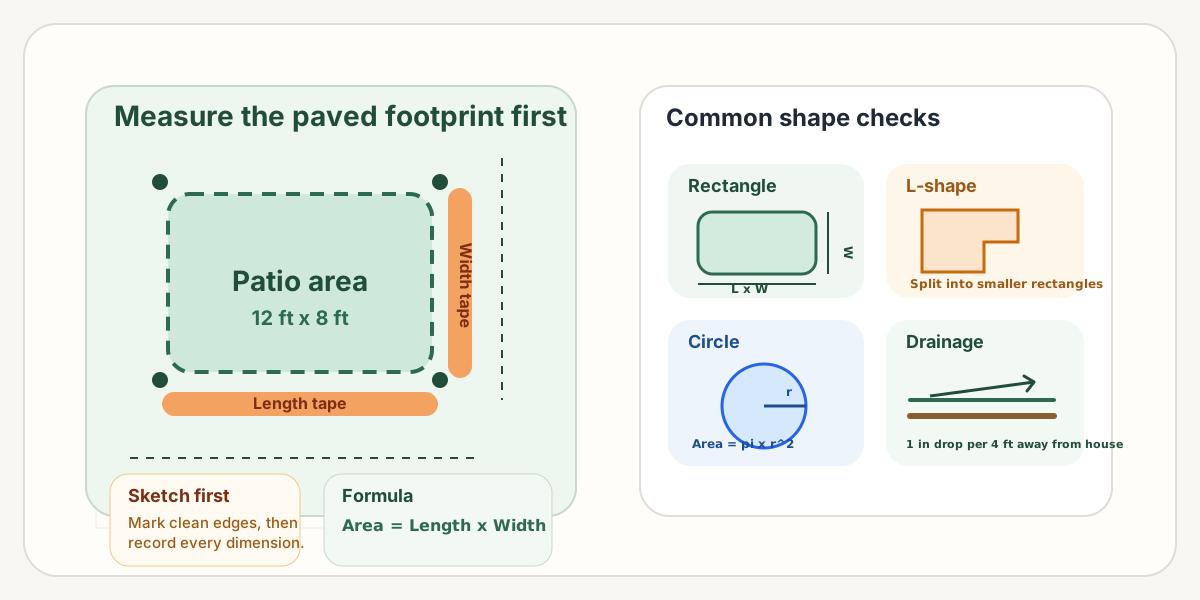
Rectangles are the easiest shape to measure and the best place to start. Even if the finished project is more complex, find the largest clean rectangle first and work outward from there.
Sketch your area
Draw a quick top-down sketch on graph paper. Mark nearby structures, steps, and edges so you know exactly what is included in the paved footprint.
Measure length and width
Use the longest side for the length and the widest side for the width. Keep all field measurements in feet so the math stays consistent.
Calculate square footage
Area (sq ft) = Length (ft) x Width (ft)
A patio that is 12 ft long and 8 ft wide covers 96 sq ft.
Add a waste buffer
Final area = Area x (1 + Waste %)
Use 5% to 10% for straight layouts, and 10% to 15% for herringbone or diagonal patterns.
How to Measure an Irregular Paver Area
Irregular patios, offsets, and L-shaped layouts become much easier when you split them into smaller rectangles. Measure each clean section on its own, then add the results together.
Total area = Area 1 + Area 2 + Area 3 + ...
Example: An L-shaped patio with Area A at 10 x 8 ft and Area B at 6 x 4 ft covers 80 + 24 = 104 sq ft.
Irregular shapes do not need complicated math right away. In most residential layouts, splitting the footprint into a few subareas is faster and usually more accurate than trying to estimate the whole shape at once.
How to Measure a Circular or Curved Area
For a full circle, measure the radius first. The radius is the distance from the center of the circle to the outside edge. If you only know the diameter, divide it by 2 to get the radius.
Circle area = pi x r^2
A circular seating pad with a 6 ft radius covers about 113.1 sq ft.
How to Calculate the Number of Pavers Needed
Once the project area is measured, convert one paver into square feet, divide the total area by that number, then add extra for cuts and breakage.
Step 1: Find the area of one paver
Paver area (sq ft) = Length (in) x Width (in) / 144
A 7.7 in by 3.8 in brick covers about 0.20 sq ft.
Step 2: Divide the project area by the paver area
Pavers needed = Total project area / Paver area
A 96 sq ft patio divided by 0.20 sq ft per paver needs about 480 pieces before waste.
Step 3: Add 10% for cuts and breakage
Final quantity = Base quantity x 1.10
480 base pavers becomes 528 after adding a 10% buffer.
| Paver size | Single paver area | Pavers per sq ft |
|---|---|---|
| 4 x 8 in | 0.22 sq ft | About 4.5 |
| 6 x 6 in | 0.25 sq ft | About 4.0 |
| 6 x 9 in | 0.38 sq ft | About 2.7 |
| 12 x 12 in | 1.00 sq ft | About 1.0 |
Use our free Paver Cost Calculator to instantly estimate pavers, bedding materials, and total project cost.
Joint gaps also affect the real coverage you get from each paver. If you are ordering tightly around a budget, use actual product dimensions plus the planned joint spacing instead of relying only on nominal size labels.
Common Measurement Mistakes to Avoid
Measure only once
Always confirm each critical dimension a second time before ordering materials.
Forget the waste buffer
Even clean layouts need extra material for cuts, breakage, and a small spare stock.
Use nominal instead of actual size
Catalog size and true installed size are not always identical, especially when spacer bars are involved.
Ignore joint gaps
The actual coverage area changes when you include a joint gap between pavers.
Underestimate curves
Arcs and sweeping borders create more cuts, which usually means higher waste.
Skip the slope check
Area planning is only half the job. Drainage direction matters before excavation starts.
Slope & Drainage Planning Tips
Measuring the footprint tells you how much space the project occupies. Slope planning tells you how that surface will perform after rain. A finished paver area should shed water away from the house instead of trapping it against the foundation.
Recommended slope = 1 in drop for every 4 ft of run
Set stakes and pull a string line so you can see the fall before excavation begins.
Before you dig, call 811 or your local utility marking service. It is the safest way to confirm there are no buried lines in the planned excavation zone.
Excavation depth usually combines the compacted gravel base, 1 inch of bedding sand, and the paver thickness itself. Patios often start with a 4 to 6 inch base, while driveways typically need more.
FAQ
Measure the full length and width in feet, multiply them to get square footage, then add a waste allowance. If the space is irregular, split it into smaller shapes first.
It depends on paver size. A 4 x 8 paver usually needs about 4.5 pieces per square foot, while a 12 x 12 paver needs about 1 piece per square foot.
Straight layouts often use 10% extra. Herringbone, diagonal, and more complex shapes often need 15% to 20%.
Divide the area into smaller rectangles, calculate each subarea separately, then total the results.
A common target is 1 inch of fall for every 4 feet of run, always sloping away from the house for drainage.
Yes. Joint spacing changes the installed coverage of each paver and can slightly change the final piece count.